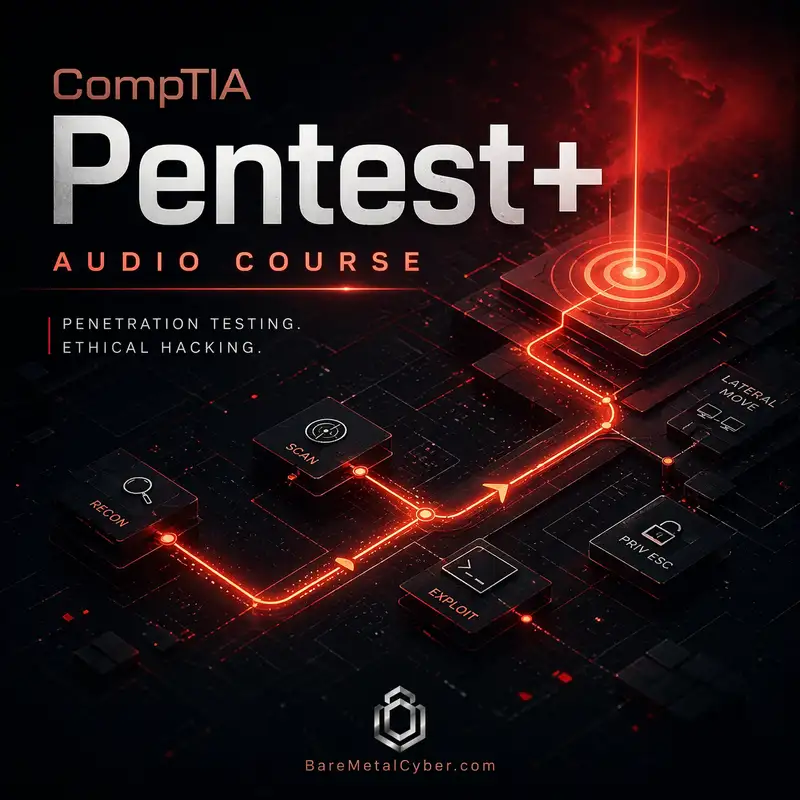
Episode 2 — The PenTest Workflow as a Timeline
In Episode 2, titled “The PenTest Workflow as a Timeline,” we’re going to take the full penetration testing workflow and lay it out as a clear sequence of phases you can mentally “walk” from start to finish. When learners say the process feels confusing, it’s usually because multiple phases get blended together in a single scenario prompt, and the exam expects you to recognize where you are on the timeline. A timeline mindset turns that confusion into structure, because you stop asking “What tool would I use?” and start asking “What phase am I in, and what’s appropriate right now?” That shift is especially valuable on PenTest+ because many answer choices are technically plausible but wrong for the moment in the workflow. By the end of this episode, you should feel a calm kind of clarity: you’ll be able to place actions in order and pick answers that fit the phase, the constraints, and the purpose.
The timeline begins with authorization and boundaries, and it stays at the front for a reason: nothing else is defensible without it. Exam questions frequently tempt you with “actionable” options before the prompt establishes permission, scope, or safety limits, and the correct answer is often the one that respects those boundaries rather than rushing into testing. Authorization is not a vague idea; it defines what systems are in scope, what methods are allowed, what data handling rules apply, and what “success” looks like for the engagement. Boundaries also include operational guardrails, such as restrictions on disruption, time windows, or systems that must not be touched. When a prompt hints at unclear permission, ambiguous scope, or a sensitive environment, place yourself at the beginning of the timeline and choose the option that resolves or honors those limits before anything else happens. In professional testing, discipline starts before the first packet ever leaves your network stack.
After boundaries are established, reconnaissance comes next, and you should think of it as gathering clues while minimizing disruption and exposure. In this phase, you are learning what exists, what is reachable, and what the environment looks like, without creating unnecessary noise or risk. The exam often describes reconnaissance as observation, discovery, or information gathering, and it is easy to confuse that with later phases that feel more “hands-on.” The key difference is intent: reconnaissance is about building an initial map, not proving an outcome. A mature tester treats reconnaissance like careful scouting, choosing approaches that reduce the chance of breaking something or tipping off monitoring more than necessary. When a prompt describes early-stage information collection, the best answers tend to favor low-impact, high-signal choices that expand understanding without assuming anything about access.
Enumeration is where those clues get turned into specifics, and it’s one of the most important transitions on the timeline. Reconnaissance tells you what might be there; enumeration helps you learn what is actually there in useful detail, such as which services are listening, which versions matter, which users or roles appear to exist, and which paths through the environment are plausible. In exam language, enumeration shows up as identifying services, finding users, mapping endpoints, or confirming what an earlier discovery really means. The timeline benefit is that enumeration is still preparation, but it is preparation with sharper edges, because you are converting general awareness into actionable understanding. It is also where you begin to see the difference between “possible” and “probable,” which sets you up for better decisions later. When you can say, “We are enumerating now,” you will naturally reject answers that assume you are already exploiting or already post-access.
Vulnerability discovery comes after enumeration, and it’s best framed as identifying weaknesses worth careful confirmation rather than collecting a pile of findings for sport. The workflow goal here is to evaluate what could be wrong, based on what you now know about systems, services, exposure, and configuration patterns. On the exam, vulnerability discovery appears as identifying likely weaknesses, matching symptoms to issues, or selecting what to investigate further given the evidence you have. This phase is not yet about proving impact; it is about building a credible list of candidates that could matter, then prioritizing which ones deserve attention based on constraints and objectives. Strong answers at this point often involve thoughtful selection, not maximal action, because the timeline still has proving and demonstrating later. When a scenario suggests you’ve identified potential issues, the right choice usually aligns with confirming what is relevant and feasible, not launching into the most aggressive possible move.
Validation is the phase that proves reality, and it is explicitly about doing so without causing unnecessary operational risk. This is where the exam wants you to show professional judgment, because validation is not the same as exploitation, and it is not a free pass to break things “for science.” Validation means confirming that a suspected weakness truly exists and is meaningful, using controlled approaches that reduce harm and respect the constraints described in the prompt. The timeline cue is that you are still establishing truth, not demonstrating full capability, and the best answer choices often show restraint. If a prompt mentions production sensitivity, limited time, or safety concerns, validation becomes even more about choosing methods that confirm the issue without triggering avoidable downtime. A good tester proves what is necessary and no more, because the goal is reliable evidence, not collateral damage.
Exploitation comes next, and it should be understood as controlled proof rather than a default impulse. The exam frequently punishes candidates who treat exploitation like the first or only meaningful step, because the workflow is about intent and sequence, not adrenaline. Exploitation is where you demonstrate that a weakness can be used to achieve a defined outcome, but “defined outcome” matters, because it ties back to the objective and the boundaries established at the beginning. In a professional mindset, exploitation is the deliberate use of a technique to prove impact, with controls to reduce risk, and with awareness of what you are authorized to do. On PenTest+ questions, the “best” exploitation answer is often the one that is specific, controlled, and consistent with the phase, rather than the broadest or most destructive option. If an answer sounds powerful but ignores safety, scope, or the need for validation, it often belongs to a different workflow—one you should not be modeling.
Once access is achieved, post-access goals come into view, and the exam wants you to think in terms of proving impact, collecting evidence, and limiting harm. Post-access is where you demonstrate what the access means, not merely that it exists, and that distinction is frequently tested. The “prove impact” idea is about showing meaningful consequences within authorization, such as what data could be reached, what systems could be influenced, or what security controls were bypassed, in a way that supports credible reporting later. Evidence collection matters because the result needs to be explainable and reproducible, which is the difference between an impressive story and a professional finding. Limiting harm stays on the timeline here too, because access can create temptation to overreach, and the exam often rewards the choice that shows control and restraint. When the prompt indicates you are post-access, choose actions that clarify impact and preserve stability rather than actions that expand chaos.
Lateral movement is the workflow’s purposeful expansion, and it is always tied to stated objectives rather than curiosity. In exam scenarios, lateral movement can be hinted at through language about moving from one system to another, using one foothold to reach additional assets, or exploring trust relationships and internal paths. The key is “purposeful,” because lateral movement without objective alignment is often out of bounds, and it increases risk in ways that are hard to justify. The timeline model reminds you that lateral movement is not a mandatory phase; it is a decision based on goals, constraints, and what evidence you still need. Many wrong answers assume lateral movement is automatic the moment you gain access, but mature testing uses it only when it supports proving impact or meeting the engagement’s defined outcomes. When the prompt emphasizes boundaries, safety, or limited scope, the best answer is often the one that does not expand without a clear, permitted reason.
Persistence and cleanup thinking appear in the workflow because professional testing aims to leave the environment stable afterward. Even when the exam describes persistence concepts, it generally expects you to treat them with ethical and operational care, emphasizing that any persistence mechanisms used for testing must be controlled, justified, and removed. Cleanup is not an afterthought; it’s part of what makes the engagement responsible and credible, because it reduces the chance that testing actions create lingering risk. On the timeline, this phase is about restoring the environment to a known-good state, documenting what was changed, and ensuring that no unnecessary access paths remain. Questions may frame this as “leaving the environment stable,” “removing artifacts,” or “ensuring no lasting impact,” and those cues should guide you away from answers that imply careless leftovers. A strong exam mindset treats stability as a deliverable, not a courtesy.
Reporting is where the entire timeline becomes valuable, because reporting translates actions into risks, impacts, and recommendations that stakeholders can actually use. The exam wants you to understand that a penetration test is not complete when you “get in,” but when you can communicate what happened, why it matters, and what should be done about it. Reporting is a translation task: technical steps and observations get turned into statements of risk, proof of impact, and prioritized guidance, all while remaining accurate, scoped, and professional. A timeline perspective helps because it makes your narrative coherent, showing how you progressed from authorized boundaries to validated findings to controlled proof and documented outcomes. It also encourages disciplined evidence handling, because good reporting is built from defensible observations rather than vague claims. When a prompt asks what to do after testing or how to present results, the best answers tend to focus on clarity, relevance, and actionable outcomes rather than technical theatrics.
Now let’s walk a short story through the timeline so you can hear each phase as a distinct moment, not a blur of “security stuff.” Imagine a consultant receives permission to assess a defined set of internal systems under strict non-disruption rules, and the work begins by confirming exactly what is in scope and what methods are permitted. Next, the consultant gathers early clues about reachable hosts and exposed services in a way that minimizes impact, treating the environment as sensitive and monitored. Then those clues are enumerated into specifics, identifying which services and access paths are real and which are dead ends, and that detail becomes the foundation for identifying potential weaknesses. From there, the consultant selects the most relevant candidate weaknesses and validates them carefully, confirming what is true without causing unnecessary operational risk. Only after validation does controlled exploitation occur to prove meaningful impact, followed by post-access actions that collect evidence, demonstrate consequences within scope, and avoid harm, with lateral movement considered only when it supports the objective and remains permitted. Finally, persistence is treated as a controlled concept with cleanup as a responsibility, and the entire narrative is captured in reporting that explains risk, impact, and recommendations in stakeholder language.
To make this timeline stick in memory, you want an anchor phrase that you can repeat internally when you face a confusing prompt. A useful anchor is one that carries the journey from permission to proof to communication, because that is the logic the exam keeps testing. Think of the workflow as: permission first, learn next, confirm carefully, prove with control, then explain clearly. That phrase is short enough to recall quickly, but it also contains the key transitions that separate phases that often get mixed up, especially reconnaissance versus enumeration, and validation versus exploitation. The value of an anchor is that it keeps you from jumping ahead when an answer choice tries to lure you into a later phase too early. When you can say the anchor in your head, you can also ask, “Where am I in that sequence right now?” and that question often points directly to the correct choice.
As we close this episode, the goal is to leave you with a workflow you can mentally place on a straight line, even when the exam wraps it in a short story. Start with authorization and boundaries, move through reconnaissance and enumeration, identify and validate weaknesses, and then use controlled exploitation only when it serves the objective under the constraints. After access, prove impact and gather evidence while limiting harm, expand laterally only with purpose, and treat cleanup and stability as part of professional responsibility. Finish by translating the work into reporting that communicates risk, impact, and recommendations with precision. To apply this today, take one scenario event you remember from any practice question—something like “found a service,” “confirmed a weakness,” or “gained access”—and place it on the timeline, because that single placement is how the sequence becomes intuitive rather than theoretical.